
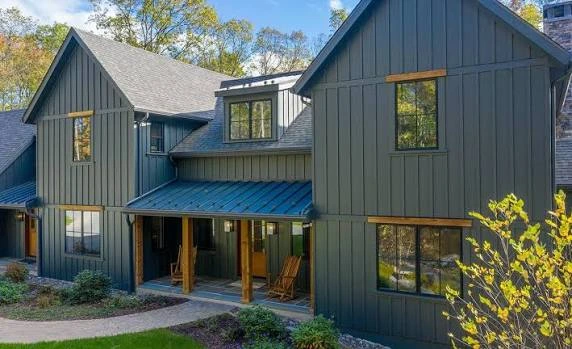
Although siding may be chosen on the basis of style, the real decisions behind a successful project which will last thirty years or more are taken at the wall assembly stage. In addition to the cladding, the sheathing, water-resistive barrier, drainage plane, flashing and fasteners all need to be chosen with care. After a decision has been made about the requirements of a particular house, the choice can then be made from two or three materials which will meet the needs of the property.
Read the wall before you read the sample board
Start by looking at the wall behind the exterior surface of the building, whether it’s a 1920s house with sheathed walls of wide board sheathing, no housewrap, and plaster-filled interior walls, or a 2005 specimen with OSB sheathing protected by a layer of polyethylene plastic film. Externally applied claddings of heavy, low-permeability material need to be combined with assemblies that are designed to dry outward. Bulk water and high quantities of vapor which penetrate the exterior surface of the building will be trapped within the sheathing if such a combination is not achieved, and no amount of caulking around joints will ever rectify this type of damage.
Weight, fastening, and substrate condition
Cement board siding (such as Hardi-plank) for example requires a substrate able to distribute the weight of the material and hold screws at the required spacing. Foam sheathing is typically easy to nail through but requires documentation of the specific fasteners used. Vinyl and aluminum siding are generally flexible enough to be ‘hanging’ as opposed to bearing on the sheathing and can therefore be more forgiving of degraded sheathing or highly irregular framing; however, they will still reveal any ‘out of plane’ variation in the framing.
How climate narrows the field
There are four principal things which cause most failures of exterior wall coverings
- Freeze-thaw cycling. Absorptive materials that stay wet will spall or delaminate. Fiber cement performs well when cut edges are sealed and ground clearance is maintained; untreated wood and poorly detailed stucco do not.
- High UV and heat. Dark vinyl on a south or west elevation can distort, particularly near reflective glazing. Specify heat-stable formulations or move to a painted product.
- Coastal salt exposure. Aluminum and uncoated steel fasteners corrode quickly. Stainless fasteners and factory-finished products with marine-grade warranties are the practical baseline.
- Wildfire exposure. Noncombustible or ignition-resistant cladding with closed soffits and ember-resistant vents matters more than the siding material alone.
Mixed-humid and cold-climate practice
In regions with fluctuating humidity between the wet winter months and hot summer months, many construction teams go with the approach of a rainscreen gap behind the siding to allow the siding and the sheathing to dry. This approach often involves the use of fiber cement or engineered wood, often paired with furring strips. If your house sits in one of these freeze-thaw regions, it is worth asking experienced siding contractors in Canton OH how they detail that drainage gap before you settle on a cladding material.
Comparing the common options
| Material | Best suited to | Main failure mode | Maintenance cadence |
| Vinyl | Simple geometry, budget-sensitive projects, moderate sun exposure | Impact cracking, thermal distortion, loose panel locks | Wash annually, no refinishing |
| Fiber cement | Mixed climates, fire-prone areas, traditional profiles | Edge swelling from unsealed cuts, caulk joint failure | Repaint roughly every 10 to 15 years |
| Engineered wood | Cold climates, large panels, sites needing lighter handling | Moisture wicking at bottom edges and penetrations | Repaint every 8 to 12 years |
| Cedar or redwood | Historic restoration, high-design elevations | Cupping, finish failure on sun-exposed faces | Refinish every 4 to 8 years |
| Metal panel | Modern designs, wildfire zones, low-slope wall geometry | Oil canning, coating scratches, galvanic corrosion | Inspect fasteners and coating every few years |
| Stucco or masonry veneer | Dry or Mediterranean climates, established regional styles | Trapped water at missing weeps and flashing | Repair cracks as they appear |
Matching material to house type
While weather is a key factor in choosing a siding material, the architecture of a home’s façade is just as important. Reveal, corner treatment, and trim depth all must read correctly for a given architectural style.
Older and historic homes
There are two ways to reproduce the look of a very narrow exposure of older siding, use thin strips of siding or use a very thick siding (such as fiber cement or engineered wood) in a 4 to 5 inch exposure. Wide vinyl panels with thin trim do not have the same look. Some very regulated districts do not allow the use of long, thin vinyl siding for side walls.
Complex elevations and multi-story walls
In addition to mere square footage, the other factors to allocate in siding costs are for failure. And there are three components that repay in greater degree of failure than others, Inspection, Consultant, and Architectural. Of course, some of these are merely visible. And all are conceivable to ‘hold back’ on (i.e. Not to specify). But not on items that add no value (i.e. None). Accent items (decorative) and trim items (for hidden elevations) and other specialty items are examples.
Where to spend and where to hold back
Rank your three budgets from highest risk of failure to highest risk of failure. The three line items that will get the most value out of your increased siding budget are typically the three biggest failure items for any given house.
- Flashing at windows, doors, roof-wall intersections, and deck ledgers, detailed with the barrier rather than caulked over.
- A drainage gap, whether furring strips or a drainage mat, on any wall facing prevailing weather.
- Factory-applied finishes over field painting, which give more consistent film thickness and longer warranty coverage.
Holding back on decorative accents and premium trim for areas like the reverse side of walls, behind gutters & downspouts, or within tight concealment areas can provide value. Two seemingly correct solutions for a given climate and wall assembly could have vastly different “value” to different homeowners based on their acceptable level of maintenance and their intended length of ownership.